When you buy through links on our articles, Future and its syndication partners may earn a commission.

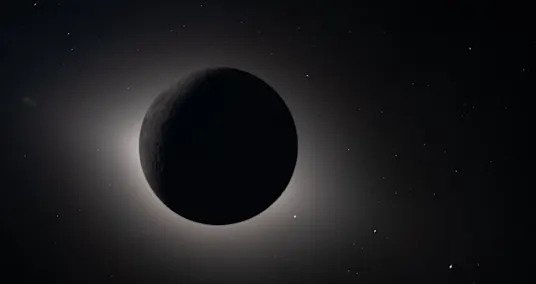
NASA's Artemis 2 astronauts have witnessed one of the rarest sights in spaceflight history — a total solar eclipse from beyond the moon.
The event unfolded yesterday (April 6) as the Orion spacecraft looped around the far side of the moon. This trajectory placed the crew in the right place at the right time to see the moon completely block the sun for about 53 minutes, which is far longer than the maximum period of totality for eclipses seen from Earth.
But it wasn't just the duration that made this eclipse extraordinary; it was the view.
NASA astronaut Victor Glover described the scene unfolding as the sun vanished behind the lunar disk.
"This continues to be unreal. The sun has gone behind the moon and the corona is still visible. It's bright and creates a halo almost around the entire moon," Glover said.
As darkness fell, another phenomenon quickly emerged. "When you get to the Earth side, the earthshine has already shown … almost seconds after the sun sets behind the moon, you can see earthshine," he added.
From Orion's windows, the crew was able to make out the faint glow of sunlight reflected off Earth, while stars and planets appeared in the background. The moon itself became a stark silhouette: "This black orb out in front of us," as Glover described it, edged by the glowing solar corona.

Though a rare sight, it's not the first time a solar eclipse has been viewed from lunar realms. The Apollo astronauts, who orbited the moon rather than flew by it (as Artemis 2 did), also saw solar eclipses, NASA's Kelsey Young, Artemis science flight operations lead, said during a press conference on Saturday (April 4).
The eclipse marks just one highlight in an already historic mission. Artemis 2 is the first crewed journey to the moon since Apollo 17 and has already set a new distance record for human spaceflight.
Following their impressive lunar flyby, the astronauts are now heading back toward Earth and are expected to splashdown on Friday (April 10) off the coast of San Diego.
LATEST POSTS
- 1
 Hanwha Ocean secures orders worth $866m for five vessels
 - 2RFK Jr.’s vaccine advisers plan biggest change yet to childhood schedule
- 3World's oldest known tortoise still very much alive despite rumor to the contrary
- 4FDA adds strongest warning to Sarepta gene therapy linked to 2 patient deaths
- 5Two more UN peacekeepers killed in southern Lebanon: UNIFIL





- Fossils unearthed in Morocco are first from little-understood period of human evolution
- Ober Gabelhorn glacier reveals remains of man missing for over three decades
- Best Augmented Simulation Ride: Which One Feels Generally Genuine?
- New materials, old physics – the science behind how your winter jacket keeps you warm
- Most loved Seared Chicken: Which Chain Rules?
- Investigating the Financial History of the World: A Succinct Outline
- Cuba fights to contain spread of mosquito-borne chikungunya virus
- Why some African countries are prone to military takeovers
- How 2025 became the year of comet: The rise of interstellar 3I/ATLAS, an icy Lemmon and a cosmic SWAN


