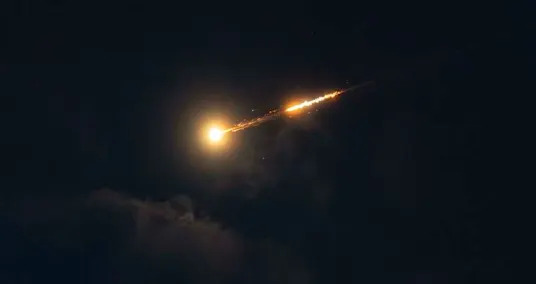
MOSCOW (Reuters) -A Russian Soyuz MS-28 spacecraft with two Russian cosmonauts and one NASA astronaut on board successfully docked with the International Space Station on Thursday, Russian space agency Roscosmos said.
But the agency later reported that the launch pad at the Baikonur Cosmodrome in Kazakhstan had sustained damage from the launch. It said the damage would be quickly repaired.
The Soyuz 2.1a rocket lifted off from the Baikonur Cosmodrome at 12:28 p.m. Moscow time (0928 GMT).
Late on Thursday, Russian news agencies quoted Roscosmos as saying the launch had taken place without incident, but damage was observed after an inspection of the launch area.
"Damage to a number of elements of the launch pad was detected. An assessment of the state of the launch complex is being conducted now," the agencies quoted Roscosmos as saying.
"All the necessary reserve elements are there to restore it and the damage will be eliminated very soon."
It said the crew was on board the station and in good health.
(Reporting by Anastasia Lyrchikova; Writing by Marina Bobrova; Editing by Andrew Osborn, Ron Popeski and Bill Berkrot)
LATEST POSTS
- 1
 Pick Your Number one breakfast food
 - 2Judge sets $60K bond for Florida congresswoman accused of stealing $5M in COVID-19 funds
- 3Solar storms have influenced our history – an environmental historian explains how they could also threaten our future
- 4Dark matter may be made of pieces of giant, exotic objects — and astronomers think they know how to look for them
- 5Hidden Island Cameras Capture Rare Tasmanian Species for the First Time Ever



- France's Senate backs ban on social media platforms for under-15s
- Industrial zone damaged in Negev, falls in Sharon area after Iran fires missiles towards Israel
- Alice Wong, founder of the Disability Visibility Project, dies at 51
- Watch SpaceX launch NASA's Pandora exoplanet-studying satellite on Jan. 11
- Blue Origin's next space tourism flight will break new ground for people with disabilities
- From Certificate to Dollars: College Majors with Extraordinary Monetary Prizes
- Police arrest 18 as anti-war protests spread across Tel Aviv, Haifa, Jerusalem
- They relied on marijuana to get through the day. But then days felt impossible without it
- Our 10 favorite Space.com reader astronomy photos of 2025